Work Sharing Constructs (Loop Scheduling)
However, the above example is very simple. In most cases, we would end up doing a large list of arrays with complex computations within the loop. Therefore, the workload should be optimally distributed among the threads. To handle those considerations, OpenMP has provided the following loop-sharing clauses: Static, Dynamic, Guided, Auto, and Runtime.
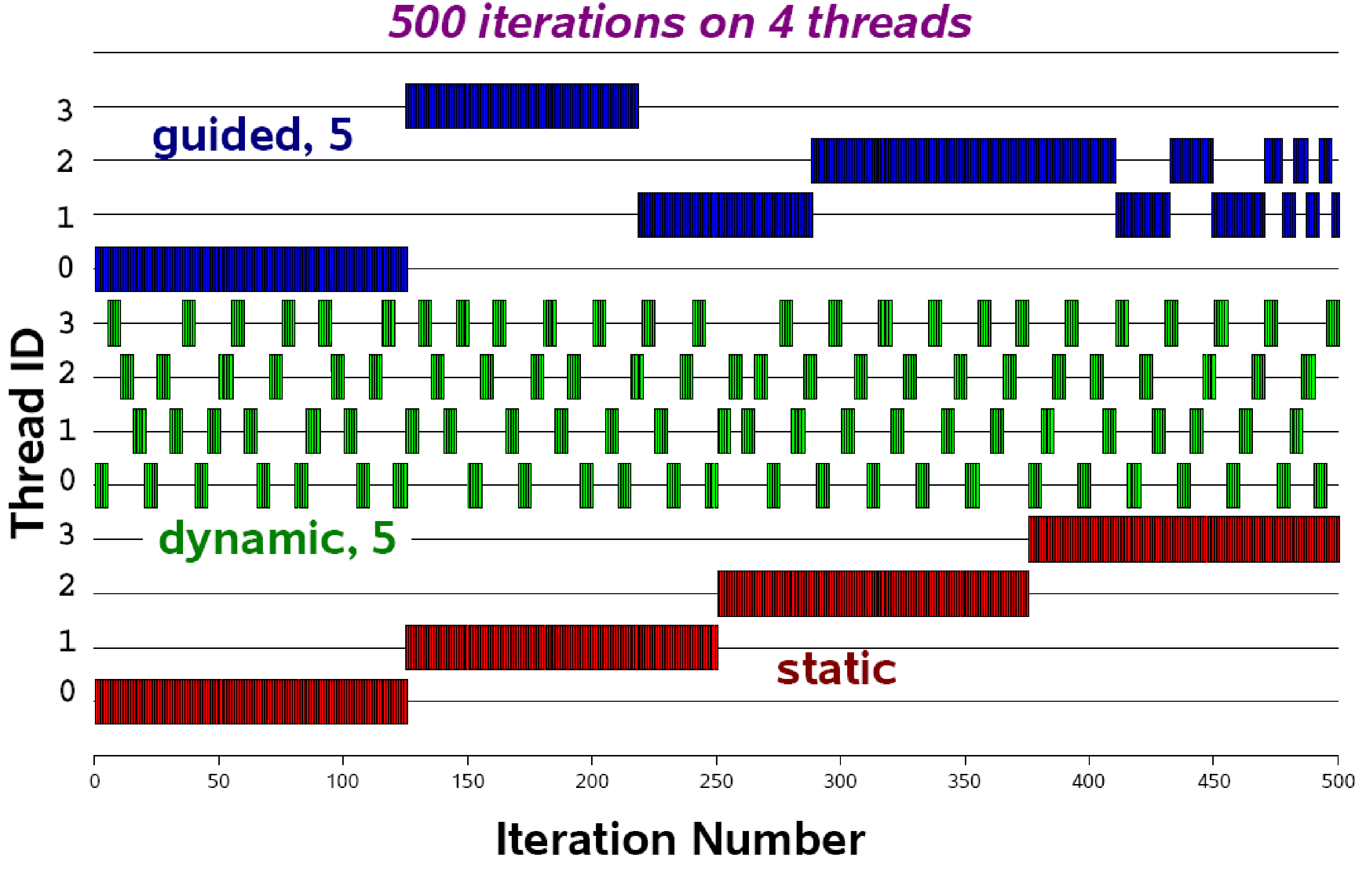
Example: Loop scheduling clauses
#pragma omp parallel for schedule(static)
for(int i = 0; i < n; i ++)
  { c[i] = a[i] + b[i]; }

// or

#pragma omp parallel
#pragma omp for schedule(static)
for(int i = 0; i < n; i ++)
  { c[i] = a[i] + b[i]; }
!$omp parallel do schedule(static)
do i = 1, n
  c(i) = a(i) + b(i)
end do
!$omp end parallel do

! or

!$omp parallel
!$omp do schedule(static)
do i = 1, n
  c(i) = a(i) + b(i)
end do
!$omp end do
!$omp end parallel
Static
The number of iterations are divided by chunksize.
If the chunksize is not provided, iterations will be divided by the size of the team of threads.
Useful when the computational cost is similar for each iteration.
Examples and Question: static
#include <iostream>
#include <omp.h>
using namespace std;
int main()
{
 int N = 10;
 omp_set_num_threads(5);

#pragma omp parallel for schedule(static)
for(int i = 0; i < N; i++)
   { cout << " Thread id" << " " << omp_get_thread_num() << endl; }

  return 0;
}
program main
use omp_lib
implicit none

integer :: n, i
n = 10

call omp_set_num_threads(5)

!$omp parallel
!$omp do schedule(static)
do i = 1, n
  print*, 'Thread id', omp_get_thread_num()
end do
!$omp end do
!$omp end parallel

end program main
Thread id           0
Thread id           0
Thread id           4
Thread id           4
Thread id           3
Thread id           3
Thread id           2
Thread id           2
Thread id           1
Thread id           1
Questions
What happens if you set the chunksize, for example,
schedule(static,4)? What do you notice?
Dynamic
The number of iterations are divided by chunksize. Default chunksize is 1.
Useful when the computational cost is different in each iteration.
Examples and Question: dynamic
#include <iostream>
#include <omp.h>
using namespace std;
int main()
{
 int N = 10;
 omp_set_num_threads(5);

#pragma omp parallel for schedule(dynamic)
for(int i = 0; i < N; i++)
   { cout << " Thread id" << " " << omp_get_thread_num() << endl; }

  return 0;
}
program main
use omp_lib
implicit none

integer :: n, i
n = 10

call omp_set_num_threads(5)

!$omp parallel
!$omp do schedule(dynamic)
do i = 1, n
  print*, 'Thread id', omp_get_thread_num()
end do
!$omp end do
!$omp end parallel

end program main
Thread id  2
Thread id  4
Thread id  2
Thread id  2
Thread id  2
Thread id  2
Thread id  1
Thread id  3
Questions
What happens if you set the chunksize, for example,
schedule(dynamic,4)? What do you notice?Do you notice if the iterations are divided by the chunksize that we set?
Guided
Similar to dynamic scheduling, but the chunk size decreases proportionally to the number of unsigned iterations divided by the number of threads.
Default chunksize is 1. Useful when there is poor load balancing at the end of the iteration.
Examples and Question: guided
#include <iostream>
#include <omp.h>
using namespace std;
int main()
{
 int N = 10;
 omp_set_num_threads(5);

#pragma omp parallel for schedule(guided)
for(int i = 0; i < N; i++)
   { cout << " Thread id" << " " << omp_get_thread_num() << endl; }

  return 0;
}
program main
use omp_lib
implicit none

integer :: n, i
n = 10

call omp_set_num_threads(5)

!$omp parallel
!$omp do schedule(guided)
do i = 1, n
  print*, 'Thread id', omp_get_thread_num()
end do
!$omp end do
!$omp end parallel

end program main
Questions
Are there any differences between
autoandguidedordynamic?
Auto
The compiler chooses the best combination of chunksize to be used.
Examples and Question: auto
#include <iostream>
#include <omp.h>
using namespace std;
int main()
{
 int N = 10;
 omp_set_num_threads(5);

#pragma omp parallel for schedule(auto)
for(int i = 0; i < N; i++)
   { cout << " Thread id" << " " << omp_get_thread_num() << endl; }

  return 0;
}
program main
use omp_lib
implicit none

integer :: n, i
n = 10

call omp_set_num_threads(5)

!$omp parallel
!$omp do schedule(auto)
do i = 1, n
  print*, 'Thread id', omp_get_thread_num()
end do
!$omp end do
!$omp end parallel

end program main
Questions
What would you choose for your application —
auto,dynamic,guided, orstatic? Have a valid reason.
Runtime
During the compilation, we simply set the loop scheduling concept via environment variable.
Example: Loop scheduling — runtime
setenv OMP_SCHEDULE="guided,4"
setenv OMP_SCHEDULE="dynamic"
# or
export OMP_SCHEDULE="guided,4"
export OMP_SCHEDULE="dynamic"
export OMP_SCHEDULE="nonmonotonic:dynamic,4"
Examples and Question: runtime
#include <iostream>
#include <omp.h>
using namespace std;
int main()
{
 int N = 10;
 omp_set_num_threads(5);

#pragma omp parallel for schedule(runtime)
for(int i = 0; i < N; i++)
   { cout << " Thread id" << " " << omp_get_thread_num() << endl; }

  return 0;
}
program main
use omp_lib
implicit none

integer :: n, i
n = 10

call omp_set_num_threads(5)

!$omp parallel
!$omp do schedule(runtime)
do i = 1, n
  print*, 'Thread id', omp_get_thread_num()
end do
!$omp end do
!$omp end parallel

end program main
export OMP_SCHEDULE="dynamic,3"

# check if you have exported the environment value
$ env | grep OMP_SCHEDULE
OMP_SCHEDULE=dynamic,3

# if you want to unset
$ unset OMP_SCHEDULE
$ env | grep OMP_SCHEDULE
# (OMP_SCHEDULE=dynamic,3) will be removed