Work Sharing Constructs (Loop)
Serial version discussion
To begin to understand the work-sharing constructs, we need to learn how to parallelise the for (C/C++) or do (FORTRAN) loop. For this, we will learn simple vector addition examples.
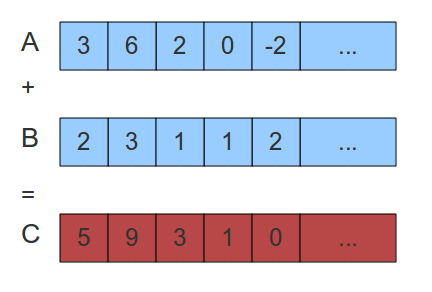
As we can see from the above figure, the two vectors should be added to get a single vector. This is done by iterating over the elements and adding them together. Since there are no data dependencies, the loop indexes do not have any data dependency on the other indexes. Therefore, it is easy to parallelise.
Examples: Loop
for(int i = 0; i < n; i ++)
  {
    c[i] = a[i] + b[i];
  }
do i = 1, n
  c(i) = a(i) + b(i)
end do
Note
FORTRAN has a column-major order and C/C++ has a row-major order
Fortran array index starts from 1
C/C++ array index starts from 0
Parallel version discussion
Now we will look into how to parallelise the for (C/C++) or do (FORTRAN) loops. We just need to add the OpenMP directives below.
Functionality |
Syntax in C/C++ |
Syntax in FORTRAN |
|---|---|---|
Distribute iterations over threads |
|
|
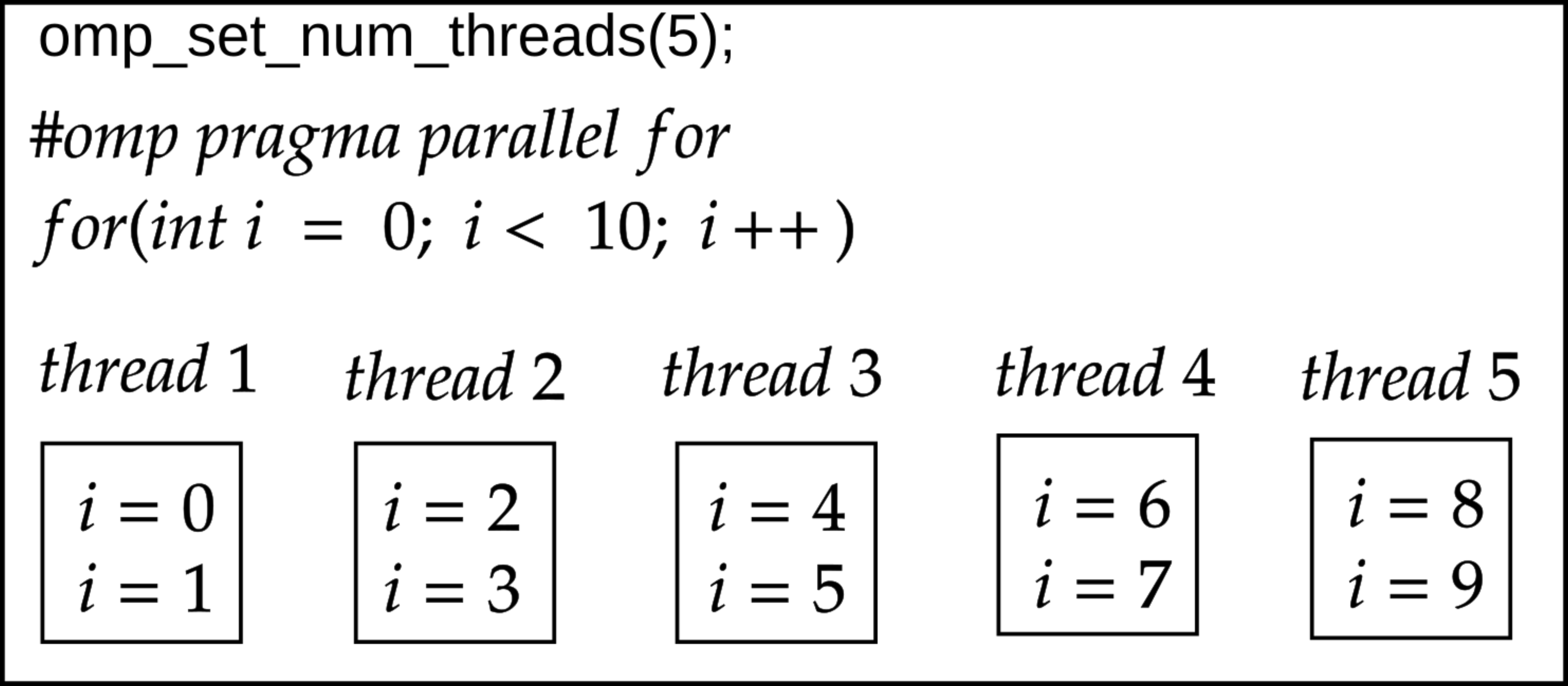
With the help of the above syntax, the loops can be easily parallelised. The figure below shows an example of how the loops are parallelised. Using 5 threads would divide 10 iterations by two — each thread handles 2 iterations.
Examples: Loop parallelisation
#pragma omp parallel for
for(int i = 0; i < n; i ++)
  {
    c[i] = a[i] + b[i];
  }

// or

#pragma omp parallel
#pragma omp for
for(int i = 0; i < n; i ++)
  {
    c[i] = a[i] + b[i];
  }
!$omp parallel do
do i = 1, n
  c(i) = a(i) + b(i)
end do
!$omp end parallel do

! or

!$omp parallel
!$omp do
do i = 1, n
  c(i) = a(i) + b(i)
end do
!$omp end do
!$omp end parallel
Questions and Solutions
Examples: Vector Addition
#include <stdio.h>
#include <stdlib.h>
#include <math.h>
#include <assert.h>
#include <time.h>

#define N 5120
#define MAX_ERR 1e-6

float * Vector_Add(float *a, float *b, float *c, int n)
{
  for(int i = 0; i < n; i ++)
    { c[i] = a[i] + b[i]; }
  return c;
}

int main()
{
  float *a, *b, *c;
  a = (float*)malloc(sizeof(float) * N);
  b = (float*)malloc(sizeof(float) * N);
  c = (float*)malloc(sizeof(float) * N);

  for(int i = 0; i < N; i++)
    { a[i] = 1.0f; b[i] = 2.0f; }

  clock_t start = clock();
  Vector_Add(a, b, c, N);
  clock_t end = clock();
  printf("Time measured: %.3f seconds.\n", (double)(end - start)/CLOCKS_PER_SEC);

  for(int i = 0; i < N; i++)
    { assert(fabs(c[i] - a[i] - b[i]) < MAX_ERR); }

  printf("c[0] = %f\n", c[0]);
  printf("PASSED\n");

  free(a); free(b); free(c);
  return 0;
}
#include <stdio.h>
#include <stdlib.h>
#include <math.h>
#include <assert.h>
#include <time.h>

#define N 5120
#define MAX_ERR 1e-6

float * Vector_Add(float *a, float *b, float *c, int n)
{
// ADD YOUR PARALLEL REGION FOR THE LOOP
  for(int i = 0; i < n; i ++)
    { c[i] = a[i] + b[i]; }
  return c;
}

int main()
{
  float *a, *b, *c;
  a = (float*)malloc(sizeof(float) * N);
  b = (float*)malloc(sizeof(float) * N);
  c = (float*)malloc(sizeof(float) * N);

  for(int i = 0; i < N; i++)
    { a[i] = 1.0f; b[i] = 2.0f; }

  clock_t start = clock();
  // ADD YOUR PARALLEL REGION HERE
  Vector_Add(a, b, c, N);
  clock_t end = clock();
  printf("Time measured: %.3f seconds.\n", (double)(end - start)/CLOCKS_PER_SEC);

  for(int i = 0; i < N; i++)
    { assert(fabs(c[i] - a[i] - b[i]) < MAX_ERR); }

  printf("c[0] = %f\n", c[0]);
  printf("PASSED\n");

  free(a); free(b); free(c);
  return 0;
}
#include <stdio.h>
#include <stdlib.h>
#include <math.h>
#include <assert.h>
#include <omp.h>

#define N 5120
#define MAX_ERR 1e-6

float * Vector_Add(float *a, float *b, float *c, int n)
{
#pragma omp for
  for(int i = 0; i < n; i ++)
    { c[i] = a[i] + b[i]; }
  return c;
}

int main()
{
  float *a, *b, *c;
  a = (float*)malloc(sizeof(float) * N);
  b = (float*)malloc(sizeof(float) * N);
  c = (float*)malloc(sizeof(float) * N);

  for(int i = 0; i < N; i++)
    { a[i] = 1.0f; b[i] = 2.0f; }

  omp_set_num_threads(omp_get_max_threads());
  double start = omp_get_wtime();
  #pragma omp parallel
  Vector_Add(a, b, c, N);
  double end = omp_get_wtime();
  printf("Time measured: %.3f seconds.\n", end - start);

  for(int i = 0; i < N; i++)
    { assert(fabs(c[i] - a[i] - b[i]) < MAX_ERR); }

  printf("c[0] = %f\n", c[0]);
  printf("PASSED\n");

  free(a); free(b); free(c);
  return 0;
}
Compilation and Output
// compilation
$ gcc Vector-addition-Serial.c -o Vector-addition-Serial

// execution
$ ./Vector-addition-Serial
// compilation
$ gcc -fopenmp Vector-addition-OpenMP-solution.c -o Vector-addition-Solution

// execution
$ ./Vector-addition-Solution
// compilation
$ gfortran -fopenmp Vector-addition-OpenMP-solution.f90 -o Vector-addition-Solution

// execution
$ ./Vector-addition-Solution
Questions
Can you measure the performance speedup for parallelising loop? Do you see any speedup?
Can you create more threads to speed up the computation? If yes or no, why?